I feel like I know how to use quotation marks, but as I was reading about the rules of them, I found that I did not know as much as i thought I did.
I learned that you should use them sparingly. they are more affective that way.
Capitalize the first letter of a direct quote, but do not use a capital when the quote is in a fragment. this is the main one I was a bit confused on. and it is still a little off to me but I found this example.
eg. Although Mr. Johnson has seen odd happenings on the farm, he stated that the spaceship "certainly takes the cake" when it comes to unexplainable activity.
I just kinda wonder why the whole thing is not in "" because it is all what he is saying.
Also if it goes in mid sentence don't capitalize.
your final punctuation should always go before the ending set of quotation marks.
http://owl.english.purdue.edu/owl/resource/577/01/
Wednesday, January 28, 2009

Tuesday, January 27, 2009
Idiot?? What??
I really enjoyed reading this article by Michael Moore. He had my full attention the whole time. I love the way he writes, its just like he would talk holding nothing back.
I kind of got a bad taste in my mouth when he started talking bad about President Bush, because i am a bush fan and felt like he has always done his best with what he has been given. also, when he was basically saying that most Americans were just brain dead loosers that sat around and watched tv all day. But as i read on and saw where Moore was coming from I agreed with a lot of his points and statements. I myself have considered being a teacher, but when you look at what they go through and the pay they are allotted its difficult to consider. I like how Moore approches this issue. He comments on how can you expect the kids of America to get a good worth while education when the funds to be able to do anything in a teaching possion is limited. It seems that America is cutting its own thoat when it comes to education. it feels that they are discouraging people from becomeing good teachers and pushing out the ones that are.
I also like how he talks about how the leaders of America say that kids are not learning enough in schools so they give more tests and make the teachers take more tests. they think the whole problem can be solved by some filled in bubbles on a sheet. I dont really want to get started on how i feel about the grading system, but its true. there is only so much a test can tell you and so much that it doesn't.
over all I liked this article. I enjoyed reading about these different oppions that Moore had and I agree with a lot of them.
I kind of got a bad taste in my mouth when he started talking bad about President Bush, because i am a bush fan and felt like he has always done his best with what he has been given. also, when he was basically saying that most Americans were just brain dead loosers that sat around and watched tv all day. But as i read on and saw where Moore was coming from I agreed with a lot of his points and statements. I myself have considered being a teacher, but when you look at what they go through and the pay they are allotted its difficult to consider. I like how Moore approches this issue. He comments on how can you expect the kids of America to get a good worth while education when the funds to be able to do anything in a teaching possion is limited. It seems that America is cutting its own thoat when it comes to education. it feels that they are discouraging people from becomeing good teachers and pushing out the ones that are.
I also like how he talks about how the leaders of America say that kids are not learning enough in schools so they give more tests and make the teachers take more tests. they think the whole problem can be solved by some filled in bubbles on a sheet. I dont really want to get started on how i feel about the grading system, but its true. there is only so much a test can tell you and so much that it doesn't.
over all I liked this article. I enjoyed reading about these different oppions that Moore had and I agree with a lot of them.
Sunday, January 25, 2009
Changing Families
I actually stayed awake while reading this little story about Changing American Families. I had to keep bringing myself back but I made it through. ha ha Anyway, I found it quite interesting to read the statistics about the different classes of American families. Once again I have never thought about the different classes in the way that they were described by Aulette.
As I read through the Moynihan Report, I couldn't believe that he would come to such a conclusion or make such a statement when his research was pretty much non existent. it seemed that all his "facts" were actually just opinions. How he accused the African American mothers in this working class of being the reason of their problems and dis function was a bit much. he also went on about how he could get, or how the men could be reinstated as head of the household. He talked of how they needed to get the masculinity back in there name. He listed that they should join the army because it boosted self-esteam and would change things to a "world run by strong men of unquestioned authority."
I loved that Aulette took this report a step further and actually went out and got the facts. She talked of how she actually went out and spent two years in these flats and viewed things in a first person way. she stated that things were indeed different than the Moynihan report stated. she listed all the good things about them, and listed facts and reasons for why things were done the way they were in these communities.
All in all this was a fairly interesting read for me. I guess I still dont exactly agree with the statements made on each individual socity, but it taught me a lot and it makes sense with the way that it was researched and documented.
As I read through the Moynihan Report, I couldn't believe that he would come to such a conclusion or make such a statement when his research was pretty much non existent. it seemed that all his "facts" were actually just opinions. How he accused the African American mothers in this working class of being the reason of their problems and dis function was a bit much. he also went on about how he could get, or how the men could be reinstated as head of the household. He talked of how they needed to get the masculinity back in there name. He listed that they should join the army because it boosted self-esteam and would change things to a "world run by strong men of unquestioned authority."
I loved that Aulette took this report a step further and actually went out and got the facts. She talked of how she actually went out and spent two years in these flats and viewed things in a first person way. she stated that things were indeed different than the Moynihan report stated. she listed all the good things about them, and listed facts and reasons for why things were done the way they were in these communities.
All in all this was a fairly interesting read for me. I guess I still dont exactly agree with the statements made on each individual socity, but it taught me a lot and it makes sense with the way that it was researched and documented.
Tuesday, January 20, 2009
semicolons
I'll be the first to admit that have never been one to use the ";". and i guess i'm not the only one. as I have been reading about them I found that it is one of our punctuation marks that is fast fading the english language. it is very seldom used which is largly due to peoples lack of understanding them.
I found that you can use them as a soft period. when you're still speaking about the same subject.
It is thought to be a more moderate pause. Between a comma and a period.
To separate sentances of equal rank when they contain internal commas
Example: Hunting is an adventure of a lifetime; it is where important life lessons are learned.
I found that you can use them as a soft period. when you're still speaking about the same subject.
It is thought to be a more moderate pause. Between a comma and a period.
To separate sentances of equal rank when they contain internal commas
Example: Hunting is an adventure of a lifetime; it is where important life lessons are learned.
Saturday, January 17, 2009
cartoons
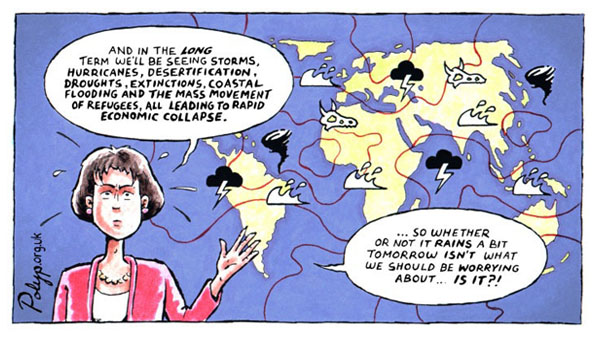

I really quite like this cartoon. It shows whats basically on everybodys mind when they are watching the news or weather. Implying that the weather dosent matter in the long term. but shows the desertification, mass movemet, coastal flodding, and all leading to economic collaps. Ha ha ha I laughed when i read the second caption "so whether it rains a bit tommorow ist' what we should be worrying about..is it?!" the media is basicly just showing that there are bigger concerns than the weather.

I am a baseball fan myself. when I saw this cartoon of Barry Bonds I just started laughing. its a shame that he had to go out the way he did, because of how many people looked up to him. this cartoon dipicts a very "unnaturally" sized Barry hitting a home run. but the ball is not a ball. it is a jax. meaning pretty much every one of his homeruns is void and has no meaning.
Wednesday, January 14, 2009
Those dang commas
I'm not gonna lie. My grammar is terrible, so I'm just going to start my first grammar post with the basic comma. I have always struggled with commas. I think I know where to put one and it turns out it was wrong, or I don't think I need one when I do. so I decided to read up and refresh on them. I relearned about the "fanboys" meaning I use a comma before for, and, nor, but, or, yet, and so. I am also supposed to use them after an introductory clauses or phrases. such as after, although, as, because, if, since, and when. I also learned that I do not use a comma to set off essential elements of the sentence. like that.
there are so many rules for these dang little squiggles and People have written books on them, but i feel that by reading this website it has helped me understand the rule a bit better, and I look forward to be able to use them right.
http://owl.english.purdue.edu/handouts/grammar/g_comma.html
there are so many rules for these dang little squiggles and People have written books on them, but i feel that by reading this website it has helped me understand the rule a bit better, and I look forward to be able to use them right.
http://owl.english.purdue.edu/handouts/grammar/g_comma.html
Sunday, January 11, 2009
To each their own
I think that Soto did a fine job of useing a little Hispanic boy to depict the seemingly "idealic" nature of a white family. Soto was able to keep my attention better by using a story line rather than the factual writing of "What we really missed about the 50's. however both writings were very interesting to me and opened my eyes to not only family but how everything is not always what it seems.
In the first essay, it took me back to where I spent a couple years of my life, the Gillbert Isands. I remember seeing some of the very first television's arrive in those Islands and that was in 2004! crazy. The shows they watched were fairly violent and they believed everything they viewed to be REAL. I remember one instance as We were walking down the street and there were a group of people huttled around a grass hut watching Die Hard. One of them saw us and yelled, "Imatang, nako mai taraia te bwai aei!" or "White kid get over here and check this out!" they were all wound up and they asked me, " Is this what Americans do? Just drive around in really fast vehicles and shoot people?" then someone got shoot in the movie and everyone went, "AAAAHHH, he just shot that guy! now he is really dead!" I had to explain to them how it was not really dead but it was just a movie and was not real but for "Entertainment." I saw a lot of the same thing in Sotos message. how you can see things on tv and think that that is the way it is or supposed to be. when in reality all it has to be is what you want and feel good about.
I think that the 50's article could both challange or critique cultural beliefes depending on who is reading it. whether that is someone who grew up during the time or some one like myself who did not. I really enjoyed reading this article though. I, like most people i guess, thought that the 50's were great and a fairly idealic time to grow up. but after reading, it opened my eyes to all the problems hidden on the inside. how pople carried their problems differently and coped with more. It was Shocking to read all the facts about the 50's and and how the author came to the conclusions that he did. things were quite different then than they are now and people reacted differently because of diffent ideals and upbringings that doesent meen that it was bad or good, but it was how it was then.
I feel that both authors were driving at the same point. That is, as my title states, "To each their own." No matter what ethinic background, color of skin, place of residence, or decade/ time period people grow up in it will always have its goods and bads. there are good things about the 50's and some not so good. there are good things and values about today and some that are not so good. The grass is not always greener on the other side, and what we see or think we see is not always right. I think that it is good for us to allways being improving on what we have and be happy with that. I think both authors did this or tried to get us to see that there is not really anything that is perfect or idealic and that dosent necessaraly mean bad but that there is allways pros and cons to every part of life.
In the first essay, it took me back to where I spent a couple years of my life, the Gillbert Isands. I remember seeing some of the very first television's arrive in those Islands and that was in 2004! crazy. The shows they watched were fairly violent and they believed everything they viewed to be REAL. I remember one instance as We were walking down the street and there were a group of people huttled around a grass hut watching Die Hard. One of them saw us and yelled, "Imatang, nako mai taraia te bwai aei!" or "White kid get over here and check this out!" they were all wound up and they asked me, " Is this what Americans do? Just drive around in really fast vehicles and shoot people?" then someone got shoot in the movie and everyone went, "AAAAHHH, he just shot that guy! now he is really dead!" I had to explain to them how it was not really dead but it was just a movie and was not real but for "Entertainment." I saw a lot of the same thing in Sotos message. how you can see things on tv and think that that is the way it is or supposed to be. when in reality all it has to be is what you want and feel good about.
I think that the 50's article could both challange or critique cultural beliefes depending on who is reading it. whether that is someone who grew up during the time or some one like myself who did not. I really enjoyed reading this article though. I, like most people i guess, thought that the 50's were great and a fairly idealic time to grow up. but after reading, it opened my eyes to all the problems hidden on the inside. how pople carried their problems differently and coped with more. It was Shocking to read all the facts about the 50's and and how the author came to the conclusions that he did. things were quite different then than they are now and people reacted differently because of diffent ideals and upbringings that doesent meen that it was bad or good, but it was how it was then.
I feel that both authors were driving at the same point. That is, as my title states, "To each their own." No matter what ethinic background, color of skin, place of residence, or decade/ time period people grow up in it will always have its goods and bads. there are good things about the 50's and some not so good. there are good things and values about today and some that are not so good. The grass is not always greener on the other side, and what we see or think we see is not always right. I think that it is good for us to allways being improving on what we have and be happy with that. I think both authors did this or tried to get us to see that there is not really anything that is perfect or idealic and that dosent necessaraly mean bad but that there is allways pros and cons to every part of life.
Tuesday, January 6, 2009
What it means to be an American
As I read through the introduction of Rereading America I find the myths fairily interesting and I guess I haven't thought about things that way much. I can tell that the text will make me think and understand differently than I am used to. I kida have my own way or thoughts about things. I dont cosider myself stubborn or narrow-minded but I tend to stand fairly strong on my opions. this will be good for me.
Also, as I think about America, I think about all the "blessings" we have. It might be hard to believe, but I have lived for a few years in another country (the Gillbert Islands) and just seeing them, there way of life, there coulture, and there outlook on life makes me gratefull and honored to be an American citizen. We have so much here. I think it is important to take a step back and look at how it all came about. I like the text. It is a bit different, but it made me think a lot.
When I realy think about what it means to be an American, several things come to mind. I think about Honesty, Hard work, Freedom, and Progression. All these aspects where and are present in the characters of those who shaped and are shaping this country. I think about the founders of this great country and the types of people they were. The sense of honesty and the hard work ethics they possesed are evident in that we have a free country to live in and the ability to progress and excell in the areas of our choice. To continue to improve our lives, and more or less even have a life of our own. It is almost too bad that some people take these qualities for granted and give us a bad name. As I think about this, I just hope that I will always be a good example of being a honest hardworking American citizen and to keep my name in the same respect as it was given to me.
Also, as I think about America, I think about all the "blessings" we have. It might be hard to believe, but I have lived for a few years in another country (the Gillbert Islands) and just seeing them, there way of life, there coulture, and there outlook on life makes me gratefull and honored to be an American citizen. We have so much here. I think it is important to take a step back and look at how it all came about. I like the text. It is a bit different, but it made me think a lot.
When I realy think about what it means to be an American, several things come to mind. I think about Honesty, Hard work, Freedom, and Progression. All these aspects where and are present in the characters of those who shaped and are shaping this country. I think about the founders of this great country and the types of people they were. The sense of honesty and the hard work ethics they possesed are evident in that we have a free country to live in and the ability to progress and excell in the areas of our choice. To continue to improve our lives, and more or less even have a life of our own. It is almost too bad that some people take these qualities for granted and give us a bad name. As I think about this, I just hope that I will always be a good example of being a honest hardworking American citizen and to keep my name in the same respect as it was given to me.
Subscribe to:
Posts (Atom)